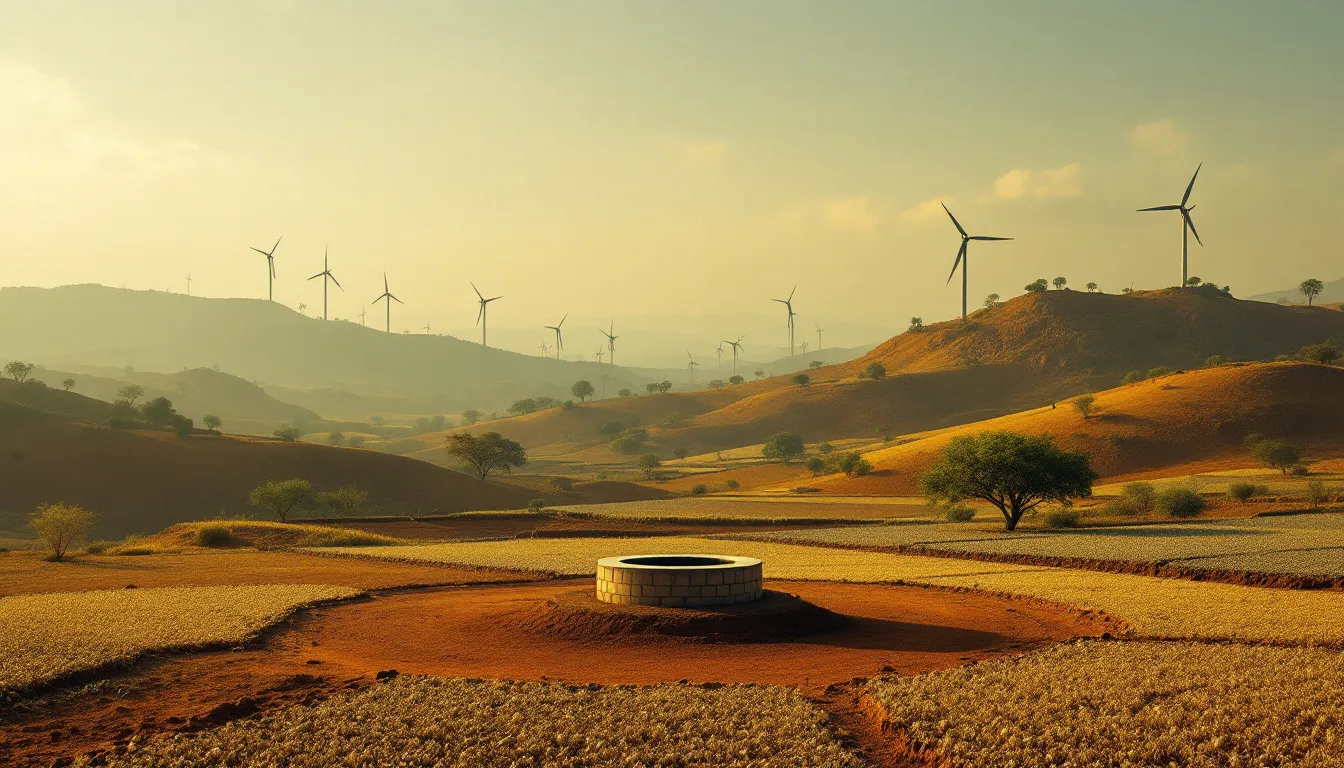
It is easy to draw a clean cycle on a slide. So let me show you what it looks like where I live and practise — Chitradurga, in Karnataka’s semi-arid Central Dry Zone. Not a model district. A hard, rainfed one, with every problem the blueprint was written for — and, it turns out, many of its answers already lying around, unconnected.
The land as it is
Chitradurga is rainfed-predominant — its harvests ride on an uncertain monsoon over black and red soils, growing groundnut, ragi, jowar, maize, sunflower, cotton and onion. The district administration itself frames its task as converting rainfed farming into something sustainable: lined farm ponds under Krishi Bhagya, soil cards under the Soil Health Mission, and extension through 22 Raitha Samparka Kendras at the hobli level.
The cost of the old way
And here is the price of growing more without growing forever: Chitradurga now draws roughly 144% of the groundwater its rains replace — among Karnataka’s most over-exploited districts, a condition the Central Ground Water Board has flagged since 1987. Falling tables, failing borewells, rising distress. This is not an abstraction in my district. It is the whole argument for an ever green revolution, written in dry wells.
The cycle is already here — in pieces
Walk the cycle node by node, and you find most of it already exists in this one dry district — built by different schemes, at different times, talking to no one else.
The Soil Health Mission already issues soil cards through the district’s Raitha Samparka Kendras — the testing node, present but advisory-thin.
Krishi Bhagya builds lined farm ponds against water scarcity — even as the district draws roughly 144% of the groundwater its rains replace.
22 Raitha Samparka Kendras sit at hobli level — the human extension node the cycle assumes, already staffed.
Chitradurga’s APMC runs on Karnataka’s Unified Market Platform: gate entry, a unique lot ID, electronic auction. The deck’s e-scales, dealer codes and national exchange — piloted in our own state, then adopted nationally as e-NAM.
PMFBY, with satellite verification, already covers crops here — the cycle’s risk node, live.
Storage
WDRA-regulated warehouses can issue electronic receipts a farmer can pledge for credit — the storage node, available.
What Chitradurga proves
The blueprint is not a fantasy waiting to be invented. In one drought-prone district its soil node, water node, extension node, market node, insurance node and storage node already exist. Karnataka even built the market node first, and the country copied it. What is missing is not the parts. It is the connection — the single, accountable cycle that makes them one. That is the whole of the work that remains.
This is the district that taught me the problem. It is also the district that convinces me the answer is within reach. Why this matters to me →
Sources
- ↗ Agriculture — Chitradurga District — District Administration, Chitradurga (Govt. of Karnataka)
- ↗ Ground Water Resource Assessment (Dynamic Ground Water Resources of India) — Central Ground Water Board (CGWB), Ministry of Jal Shakti, 2024
- ↗ ReMS — Karnataka's Unified Market Platform (UMP) — Rashtriya e-Market Services (Govt. of Karnataka × NCDEX e-Markets), 2014
- ↗ Soil Health Card scheme — Dept. of Agriculture & Farmers' Welfare
- ↗ PMFBY — Pradhan Mantri Fasal Bima Yojana — Ministry of Agriculture & Farmers' Welfare